
Plans, services, and placement
Inclusive Versus Segregated Classrooms Explained
Inclusive versus segregated classrooms affect your child's services, belonging, and progress. Learn what IEP teams must consider before any placement.
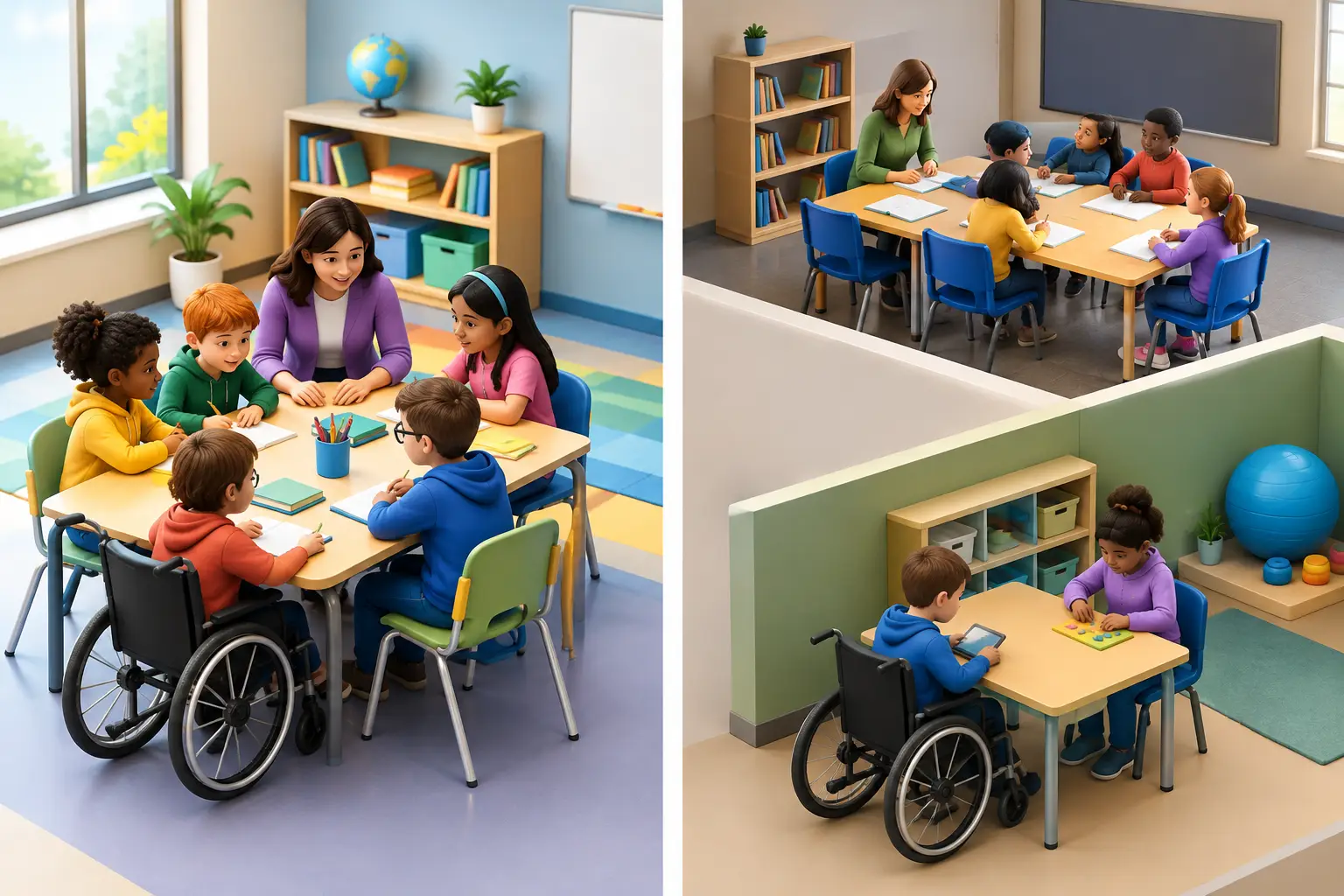
A placement decision can change the shape of your child’s school day: who they learn beside, which adults support them, whether they can join class routines, and how much they are expected to participate. The debate around inclusive versus segregated classrooms is not merely philosophical. For families, it is often about access, dignity, belonging, and whether an IEP delivers the education their child is entitled to receive.
Schools may present placement as if there is one obvious answer: the general education classroom or a separate special education setting. That is not how an individualized decision should work. Your child is not a program slot, a staffing problem, or a behavior label. The IEP team must consider your child’s unique needs, the support required to meet them, and the setting where your child can make meaningful progress.
What inclusive and segregated classrooms mean
An inclusive classroom generally means a student with a disability learns alongside nondisabled peers for all or part of the school day. Inclusion is not simply placing a child in a general education room and hoping for the best. It requires the supports, accommodations, modifications, specialized instruction, and trained staff that allow the child to participate and learn.
A segregated classroom, sometimes called a self-contained classroom or separate special education setting, serves students with disabilities apart from most nondisabled peers for a significant portion of the day. These settings can vary widely. Some offer small-group instruction, therapeutic support, intensive communication services, or structured behavioral teaching. Others may provide limited access to grade-level curriculum and fewer opportunities to build relationships with peers outside the program.
The labels alone do not tell you whether a placement is appropriate. An inclusive setting without adequate support can leave a child overwhelmed, isolated, or unable to access instruction. A separate setting that provides skilled, individualized instruction and meaningful opportunities for inclusion may be more appropriate for a child at a particular point in time. The question is never which label sounds better. The question is what your child needs to receive a free appropriate public education.
The law starts with the least restrictive environment
Under the Individuals with Disabilities Education Act, schools must educate students with disabilities in the least restrictive environment, often called LRE. This means students should be educated with nondisabled peers to the maximum extent appropriate. Removal from the general education environment should occur only when education there cannot be achieved satisfactorily, even with supplementary aids and services.
That phrase matters: even with supplementary aids and services. Before a school recommends a more restrictive setting, the team should seriously consider what supports could make general education participation successful. Depending on the child, those supports may include a paraprofessional, assistive technology, visual schedules, sensory breaks, co-teaching, speech-language support, behavior intervention, modified assignments, or specialized instruction delivered in the classroom.
LRE does not require every child to spend every minute in a general education classroom. It does require the team to avoid treating separate placement as the default simply because a child has a disability, needs intensive support, or is difficult to serve within existing staffing patterns. Convenience is not an individualized placement rationale.
Inclusive versus segregated classrooms: what families should examine
When an IEP team discusses placement, listen closely to the evidence behind its recommendation. Statements like “This program is where students like your child go” or “We do not have the staff to support that” should raise immediate concerns. Placement must be based on your child’s needs, not the school’s existing program structure.
Ask the team to explain what your child needs that cannot be provided in a less restrictive setting with supports. Ask what supplementary aids were considered, tried, or rejected, and why. If the school claims inclusion has not worked, request specific data. Was the child given appropriate accommodations? Was staff trained to implement the behavior plan? Was specialized instruction delivered as written in the IEP? Were goals, progress data, and service minutes reviewed?
A child cannot be said to have “failed” inclusion when the school failed to provide the supports the child needed to access it.
It is also fair to examine what happens in a separate setting. Ask whether your child will receive grade-level instruction, how peers are grouped, and what opportunities exist for lunch, electives, assemblies, recess, clubs, field trips, and academic classes with nondisabled peers. Separate placement should not mean separate from school life.
Progress is more than quiet compliance
Families are sometimes told a separate classroom is best because their child is calmer there, has fewer behavior incidents, or is easier to manage. Those facts may be relevant, but they are not enough on their own. A child being quiet, compliant, or removed from demands does not automatically mean they are learning.
Look for meaningful progress in the areas identified in the IEP. Is your child gaining skills? Are they receiving instruction aligned with their needs? Can they communicate, participate, build independence, and develop relationships? Are expectations appropriately high, or has the school quietly lowered the bar because a separate room is easier to supervise?
At the same time, do not let anyone pressure you into a placement that looks inclusive on paper but is harmful in practice. If your child is consistently dysregulated, unable to engage, missing instruction, or receiving support only after a crisis, the team must address that. The answer may be stronger supports in general education, a different mix of services, or a more specialized setting for part of the day. Good advocacy is not about defending a location at all costs. It is about demanding a plan that works for your child.
Placement decisions should follow the IEP, not lead it
The IEP should identify present levels, measurable goals, services, accommodations, behavior supports when needed, and progress monitoring. Only then should the team discuss the setting where those services can be delivered. When a school begins by saying, “We have a spot in this program,” it risks reversing the process.
A predetermined placement can result in an IEP written to fit the program rather than a program designed to fit the child. That is exactly the kind of institutional shortcut families should question.
During the meeting, ask the team to document your concerns and requests. If you disagree with a proposed placement, do not feel pressured to make a rushed decision just because the meeting is ending. Request the prior written notice explaining what the school proposes or refuses to do, the reasons for its decision, the data used, and other options considered. Keep copies of evaluations, progress reports, behavior data, emails, and meeting notes. Details matter when you need to hold a district accountable.
Questions to bring to the IEP table
You do not need to arrive with legal jargon to advocate effectively. You need clear questions and a willingness to ask for specifics. Consider asking:
- What supports would allow my child to participate more successfully with nondisabled peers?
- What data shows that this proposed setting is necessary?
- How will my child access grade-level curriculum and receive specialized instruction?
- What opportunities will my child have to learn and socialize with nondisabled peers?
- How will progress be measured, reported, and reviewed if the placement is not working?
- What is the plan for increasing inclusion if my child gains skills or support needs change?
These questions shift the conversation away from assumptions and toward accountability. They also make it harder for a team to rely on vague assurances such as “We will see how it goes.” Your child deserves a written plan with services, responsibilities, and measurable outcomes.
When a separate setting may be appropriate
There is no single “right” classroom for every student with a disability. Some children need intensive, direct instruction in a small group for part or all of the day. A child with significant communication, medical, sensory, behavioral, or academic needs may require a specialized environment that general education alone cannot provide, even with substantial supports.
The key is that a separate setting must be genuinely individualized, educationally meaningful, and reviewed regularly. It should not become a permanent destination because changing the arrangement is inconvenient for the district. Placement can and should change when your child’s needs, skills, and access needs change.
You are allowed to want both appropriate specialized support and real belonging for your child. Those goals are not opposites. If a school frames the conversation as an all-or-nothing choice, slow it down and ask what a thoughtful combination of settings and services could look like.
Your child’s placement is not a favor the school grants. It is an IEP team decision that must be based on evidence, individualized need, and the right to learn alongside peers whenever appropriate. Do not let urgency, staffing shortages, or a district’s preferred program make that decision for your family.
Make this specific to your child
Use YourChildCoach to turn this guidance into a plan for your child's situation.
You don't have to figure out the next step alone. Coach helps you understand what's happening and what to do next, any time it comes up. Plans start at $9 a month. Cancel anytime.
Originally published on YourChild.org.
Federal IDEA requirements provide a baseline. State law, regulations, guidance, and timelines may add or modify requirements. This page provides educational advocacy information, not legal advice.